


Seafood Packing Rubber Bands
Anyone who has packed live crab knows the failure. The band goes on at the grading table, the crab goes into the tank or onto ice, and forty minutes later the claw is open again and the next handler gets pinched. The band did not break; it slid off a shell that was wet and cold when it was put on.
Claw bands are a different job from carton bands. They sit on a hard, slick, tapered joint, they get soaked, and they sit at 0–4 °C for a day before anyone looks at them again. Three numbers decide whether the band stays: loop size against the closed claw, flat width against the joint, and the compound's grip when wet.
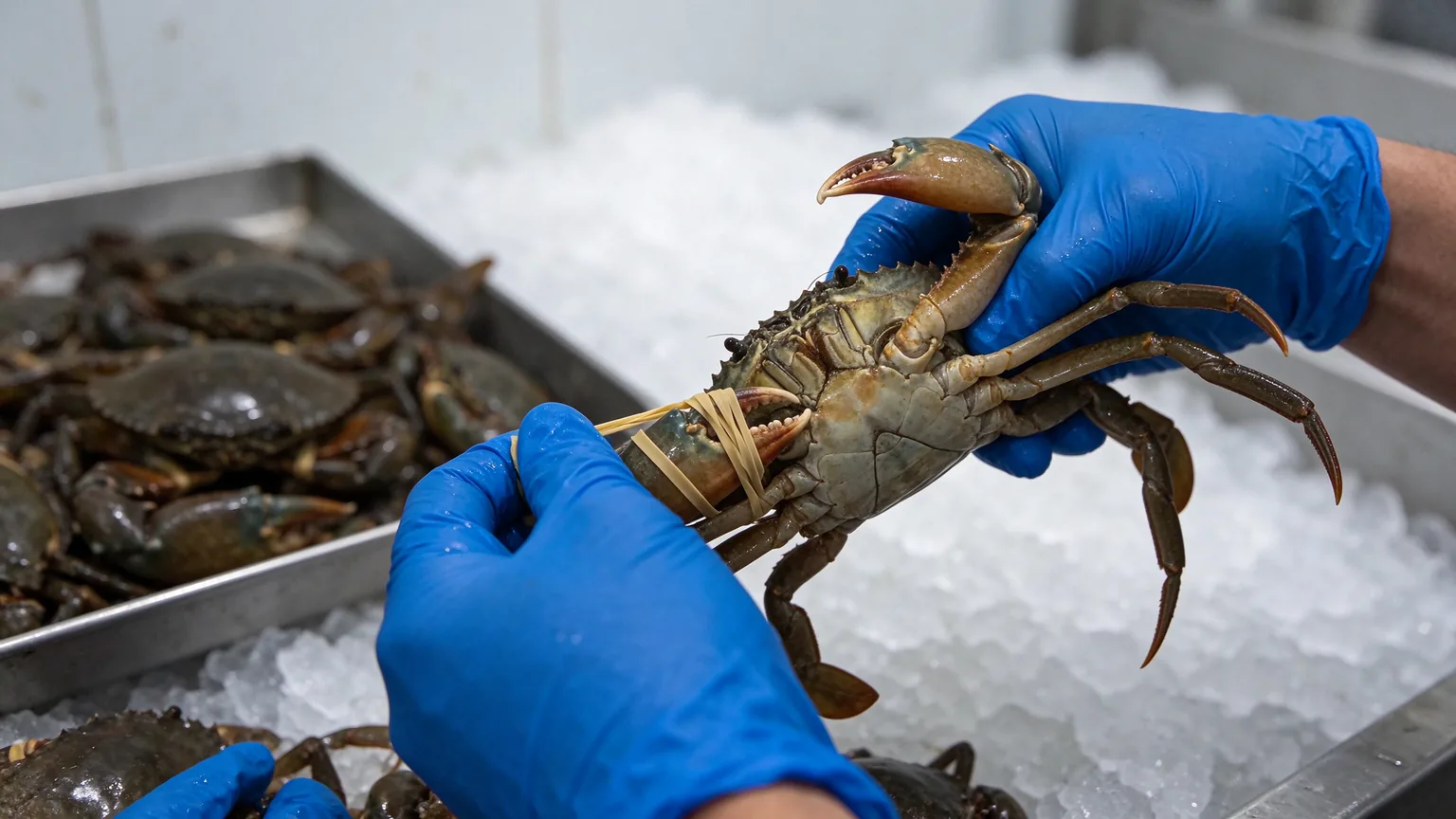
Where a claw band lets go
- Loop sized on the open claw. Size it on the closed claw, joint measured at the widest point plus 10–15 mm. A band sized on the open claw arrives already stretched and has nothing left to hold with.
- Too narrow. Under 6 mm flat width the band sits in the groove behind the joint and rolls off. 8–10 mm sits across the shell and stays.
- Smooth, heavily filled compound. A glossy band on a wet shell is a wet band on glass. The natural compound we use for seafood is deliberately slightly tacky.
- Cold. Below 5 °C natural rubber stiffens. A band that was easy to pull on at 18 °C is hard to seat in a 2 °C pack room, and an operator who fights it stretches it too far.
Sizes we ship most
| Use | What it goes round | Loop | Flat width | Wall |
|---|---|---|---|---|
| Blue swimming crab, claw | Closed claw joint, 45–55 mm | 70 mm | 8 mm | 1.2 mm |
| Mud crab, large claw | Closed claw joint, 70–90 mm | 100 mm | 10 mm | 1.5 mm |
| Lobster, both claws | Claw 60–75 mm | 90 mm | 10 mm | 1.5 mm |
| Live crab, whole body wrap | Carapace 140–170 mm | 200 mm | 20 mm | 1.5 mm |
| Shellfish bag neck | Bag neck, 60–80 mm | 90 mm | 12 mm | 1.2 mm |
Two bands per crab for export crates — one per claw — and one body band if the crate is stacked more than two deep. The body band is what stops a crab working a claw free against the crate wall.
Food contact and the paperwork
The compounds we supply for seafood packing are natural rubber with a low-filler recipe, and we issue SGS reports plus REACH and RoHS declarations with each batch. If your market asks for latex-free gloves on the same line, the same sizes are made in a silicone-free synthetic compound — ask for it under latex-free rubber bands and keep the two colours separate on the table so nobody mixes them.
Colour is a grade code
Most packers we supply run two or three colours: one for grade A, one for the second grade, one for crabs held back for shedding. It costs nothing at 100 kg and it removes the one mistake that reaches the buyer — a crate of mixed grades tied in the same colour. Custom shades and a printed size code go through rubber band customization.
Custom sizes, not the nearest bag
Loop 50–200 mm, flat width 6–25 mm, wall 1.0–2.0 mm, any colour. We run 10 lines in Dongguan, 500 tons a month, and hold sizes that no catalogue carries — the usual case is a 65 mm loop for a crab that sits between two standard sizes. Oversize loops come from the large-size range; compound choice is set out in grade selection.
FAQ
Will the band damage the shell?
Not at 1.2–1.5 mm wall and 8–10 mm width. Damage comes from a band pulled to twice its resting length, which is a sizing error, not a material one.
How long does a claw band hold?
Through a normal 24-hour tank or ice cycle, and it is usually reused once if it is rolled off rather than cut. Beyond 48 hours in salt water, expect the grip to drop and the band to be replaced.
Can you print a farm or lot code?
Yes, one or two colours on the flat face. On a wet crate the print is easier to read than a paper tag, and it does not fall off.
What to send us
Measure one closed claw around the joint, and tell us the tank temperature and how many crabs a day. We will come back with a loop, a width, a colour and a sample date. Write to amy@rubberbandking.com or message +86 189 2820 1291 on WhatsApp. Related: cold storage packing and bakery packing.
