


Greenhouse Vine Tying Bands
Tying is the most repeated job in a greenhouse and the easiest one to get wrong. A tie that is right in week three is a tourniquet by week nine, because the stem keeps thickening and the band does not. Growers see the result as a flat, pale section below the truss and a plant that stops moving water.
String and clips are the usual answer, and both have a cost: string takes two hands and a knot, clips crack under UV and drop into the gutter. A rubber band loop is one hand and no knot, which is why it survives in Dutch and Spanish tunnels — but only if the loop is sized for the stem it will be holding in August, not the seedling it went on in April.
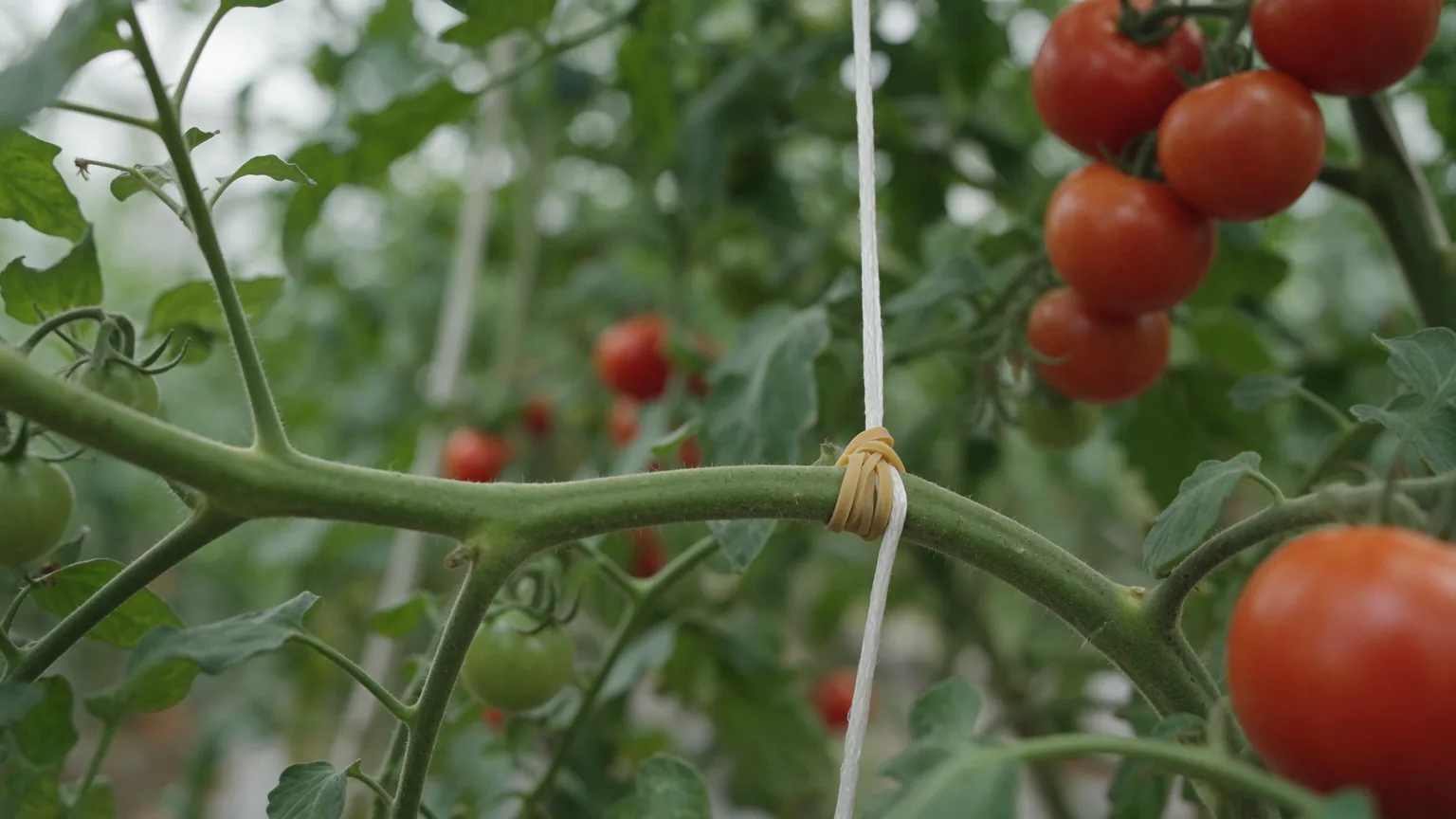
Where a vine tie goes wrong
- Sized on the seedling. A 30 mm stem becomes 45 mm. Fit at 1.3 times the stem at tying, not 1.0, so there is stretch left to give.
- Narrow band, deep groove. Under 5 mm flat width the band cuts into the epidermis at the truss node, which is exactly where the plant is working hardest.
- No UV package. Natural rubber in direct sun under glass degrades fast; by mid-season a plain band is a brittle ring that snaps when the crop is lowered. UV-stabilised EPDM holds a full season.
- Tied to the twine only. The band has to take both stem and twine, otherwise the plant slides down the string as it gains weight.
Sizes growers ask for
| Crop / stage | What it holds | Loop | Flat width | Compound |
|---|---|---|---|---|
| Tomato, seedling to first truss | Stem 12–20 mm + twine | 40 mm | 4 mm | Natural |
| Tomato, mid season | Stem 25–35 mm + twine | 55 mm | 6 mm | EPDM UV |
| Tomato, late season / beefsteak | Stem 40–50 mm + twine | 70 mm | 8 mm | EPDM UV |
| Cucumber on wire | Stem 15–25 mm + wire | 50 mm | 5 mm | EPDM UV |
| Pepper / aubergine support | Stem 20–30 mm | 60 mm | 6 mm | EPDM UV |
A working rule from growers we supply: one loop per metre of stem, plus one at each truss. On a 10 m row that is around 14 ties instead of 30 clips, and no knots.
Why EPDM for a glasshouse
Natural rubber is the cheapest and the most elastic, and it is the right answer for a short crop or a shaded tunnel. Under glass in summer, with 60 000 lux on the crop and 35 °C at the top wire, a natural band loses its elasticity in eight to ten weeks. EPDM keeps working for a full season and does not go sticky on the trellis wire. Both are supplied with SGS reports and REACH and RoHS declarations; the trade-offs are set out in grade selection.
Custom loops and colours
Loop 30–90 mm, flat width 4–10 mm, colour by variety or by crop block — red for beefsteak, yellow for cherry is the common split, because a picker reads the colour before the label. Custom shades and printed block codes go through customization; wider loops for tie-downs come from the large-size range. Latex-free is available where pickers work with gloves and a latex-free policy — see latex-free bands.
FAQ
Will the band girdle the stem?
Not if it is fitted at 1.3 times the stem and given 5 mm or more of flat width. A girdled stem is a band that was sized to fit exactly on day one.
How many bands per hectare?
At 2.5 plants per square metre and 14 ties per plant, roughly 35 000 per 1 000 m² over a season — order in two drops, seedling and mid-season, because the sizes change.
Can they be reused?
EPDM loops come off intact at crop clearance and are often reused for the next cycle's seedling stage. Natural ones are usually cut and composted.
What to send us
Tell us the crop, the stem diameter at mid season, and whether the tunnel is glass or plastic. We will match a loop and a compound, and send a sample strip for a trial row. Write to amy@rubberbandking.com or message +86 189 2820 1291 on WhatsApp. Related: orchard tying and vegetable bundling.
