


Seafood Rubber Bands
A crab does not lose value on the ice. It loses value in the eighteen hours before that — in a crate, in the dark, working one claw free of a band that was never tight enough, then tearing the other crab’s legs off to get loose. By the time the tray reaches the buyer, ten percent of the catch is damaged and nobody can tell you where it happened.
We make rubber bands for seafood: crab claw bands, lobster bands, bundling loops for prawns and shellfish, in natural rubber and latex-free compounds. Below is what buyers in live-seafood export keep asking us, and the sizing we recommend because of it.
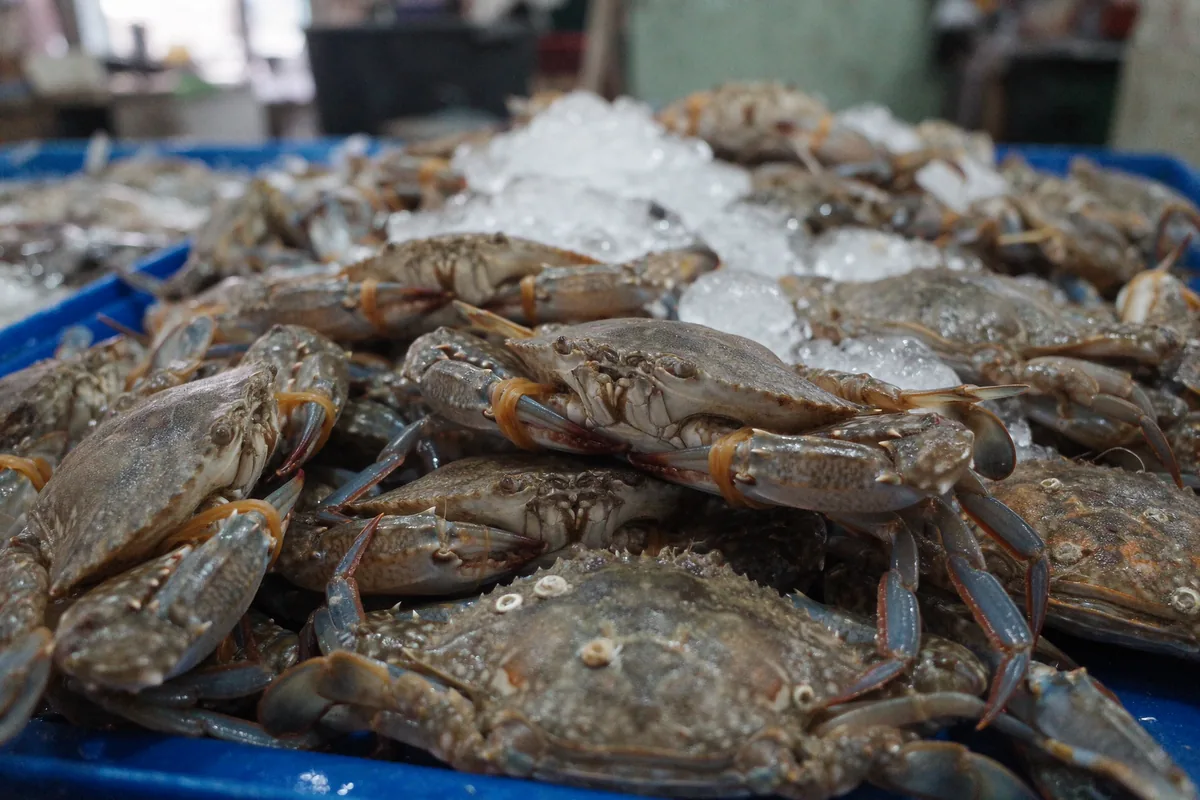
A claw band fails in transit, not at the market
Four things break a band between the boat and the buyer, and all four are boring:
- Salt and constant wetting. A band that sits in seawater, then ice water, then dries on a dock, ages faster than the same band on a shelf. Surface bloom and cracks start at the edge of the loop.
- Cold-room storage. Natural rubber stiffens sharply as temperature drops. A band stored at 2 °C and pulled onto a claw at 2 °C behaves like a different product than the one you tested at room temperature.
- Tension chosen by habit. Everyone ties with the same size because that is what the box says, not because it matches the claw in front of them. Small crabs get slack bands; large mud crabs get bands stretched to their limit.
- Cheap fillers. High filler loading gives a band that looks right, feels right on day one, and takes a permanent set by day three. It never recovers, so the second crate is looser than the first.
None of this shows on an invoice. It shows as claw loss, shell punctures, escapes, and a claim you cannot prove.
Four jobs the band is actually doing
1. Protecting the people handling the crate
A blue swimming crab can open a glove. A mud crab can take a finger. Banding both claws is the first handling rule in every packing shed we have visited, and it is the reason the band has to be quick to apply — a band that is slow to fit gets skipped under pressure.
2. Keeping the claws attached
Live crabs fight. In a stacked crate, an unbanded claw does not just pinch the neighbour; it removes legs and chelae, and every missing limb is a grade drop. A properly tensioned band takes the reach out of the claw without cutting into the shell.
3. Making grade visible at a glance
Colour coding is the cheapest quality system in a live-seafood operation: one colour per size grade, per farm, or per boat. A packer can audit a crate without weighing it, and a mis-coloured crab is obvious before the carton is sealed.
4. Carrying your mark
Printed bands — farm name, size grade, batch code — turn a consumable into a branded, traceable component. This is the part most buyers only ask about after the first claim.
Sizing by species
Loop size is set by the girth around the closed claw, not by the weight of the animal. These are the starting points we ship most; a 1–2 mm step either way is normal once you tie a full crate.
| Application | Claw / bundle girth | Suggested loop | Wall | Typical colour |
|---|---|---|---|---|
| Blue swimming crab, 80–120 g | 28–34 mm | 32 mm | 1.5–2.0 mm | Blue |
| Soft-shell crab | 30–40 mm | 35 mm | 1.5 mm | White or clear |
| Mud crab (Scylla), 300–600 g | 45–60 mm | 50 mm | 2.5–3.0 mm | Yellow |
| Lobster (Homarus), 500 g–1 kg | 70–90 mm | 75 mm | 3.0 mm | Red or blue |
| Spiny lobster / crayfish | 55–80 mm | 65 mm | 2.5 mm | Red |
| Prawn / shrimp bundle, 500 g | bundle only | 20–25 mm loop | 1.2–1.5 mm | Any |
If you send us the species, the average claw girth and how the crate is stacked, we will size the loop rather than sell you the nearest bag. For very large claws we cut from our large-size rubber band range, where the flat width stays wide enough that the band does not roll off the shell.
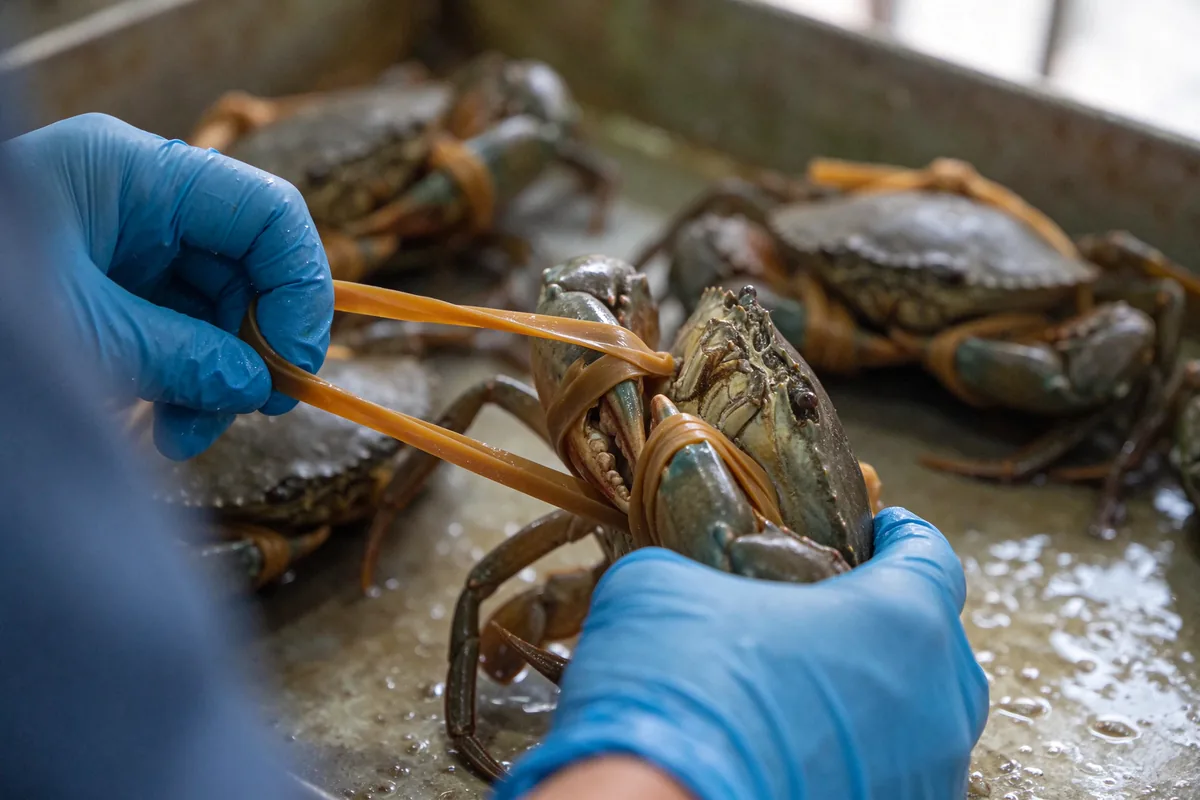
Material: what survives salt, ice and a cold room
Natural rubber
The default for claw bands: highest elongation, best grip on a wet shell, and the lowest cost per thousand. It is the right answer for short-cycle live export and for anything sold within weeks. It is the wrong answer for a band that lives outdoors in UV for a season.
Latex-free compounds
Where the destination market or the buyer’s own spec rules out natural rubber latex, we run the same shapes in latex-free compounds. Same tooling, same dimensions, no latex proteins — useful when a customer’s QA team asks the question before the first shipment rather than after.
TPU-coated and thicker walls
Salt water and repeated wetting are the real enemies of a thin band. A coated or heavier-wall band costs more per piece and lasts several trips, which matters when banding is done by the same crew on the same crates every week.
Compliance documents we can send with a quote: SGS test reports, REACH and RoHS declarations for the exact compound and colour you order. Ask for the report number matching your SKU — a generic certificate for a different compound is not evidence.
Colour coding that packing sheds actually use
Three rules cover most operations:
- One colour per size grade. Blue for the small crab, yellow for the large, red for the premium single-crab carton. A glance replaces a weighing step.
- One colour per source. Different farms or boats get different colours, so a mixed crate is visible before it is sealed.
- Dark colours hide blood, light colours show dirt. White and clear bands look clean on a new crate and show every handling mark. Black hides damage to the band itself, which is the last thing you want on a live product.
We keep stock colours — blue, yellow, red, green, black, natural amber — and produce custom shades against a Pantone reference for OEM programmes. See the coloured rubber band range for the standard palette.
Ordering, samples and minimums
Most seafood buyers start with a trial crate rather than a container, and that is the right way to do it: pull 200–300 bands through a real shift before committing. What we need to quote properly:
- Species and average claw girth (a photo with a ruler against the claw is enough).
- Crate stacking — single layer, stacked, or bagged — because it decides the wall thickness.
- Destination market and any latex-free or food-contact requirement.
- Colour, and whether the band carries print.
Samples ship in three to five days, including custom colour or print. A custom production run ships about seven days after you approve the sample. Printed and custom-shade bands fall under our rubber band customization programme; latex-free options are listed under latex-free rubber bands.
FAQ
Are these bands safe for food contact?
They are made for handling and sale of live seafood, from compounds we hold SGS reports for, with REACH and RoHS declarations. Send us the SKU and destination market and we will return the documents that match that exact compound and colour.
Can the band stay on during cooking?
No. Bands are a handling and transport component; remove them before cooking. Crab and lobster should be banded for the crate and the display tray, then unbanded in the kitchen.
Will a tight band damage a soft-shell crab?
It can. Soft-shells need a thin wall and the lowest practical tension — 1.5 mm on a 35 mm loop is where most operations settle. Test on ten crabs before you set a spec.
Do bands survive a cold room?
They perform best when stored at ambient temperature and brought out before the shift. A band pulled from 2 °C is stiffer and needs more force to fit, which is exactly when bands get torn. Keep the working box on the packing table, not in the chiller.
What is the minimum order?
It depends on size and colour; stock colours start low, custom shades and print need a higher run because of the setup. Tell us the monthly volume and we will quote the band that fits it rather than the smallest carton we sell.
What we would change first
If you are losing claws today, the fix is usually not a new supplier — it is one size. Pick the grade that accounts for most of your claim, measure twenty claws with a tape, and move that grade to the loop the measurements point at. Then put a colour on it so nobody can pick the wrong box again. Everything else in this article is secondary to that.
Send the species, the claw girth and the crate you use. We will send back a size, a compound, a colour and a sample date — not a catalogue. Write to amy@rubberbandking.com or message +86 189 2820 1291 on WhatsApp.
