


Vegetable Rubber Bands
A bunch of spring onions rarely fails because the vegetable was bad. It fails at the band: 2 mm too small, dried out after a night in the cold room, or a tension that was never the same twice in a row. On the shelf all three look identical — a loose pile of greens that nobody picks up.
We make vegetable rubber bands for wholesale markets, supermarket packhouses and produce exporters. What follows is the short version of what comes back to us as complaints, and what we changed in the product because of them.
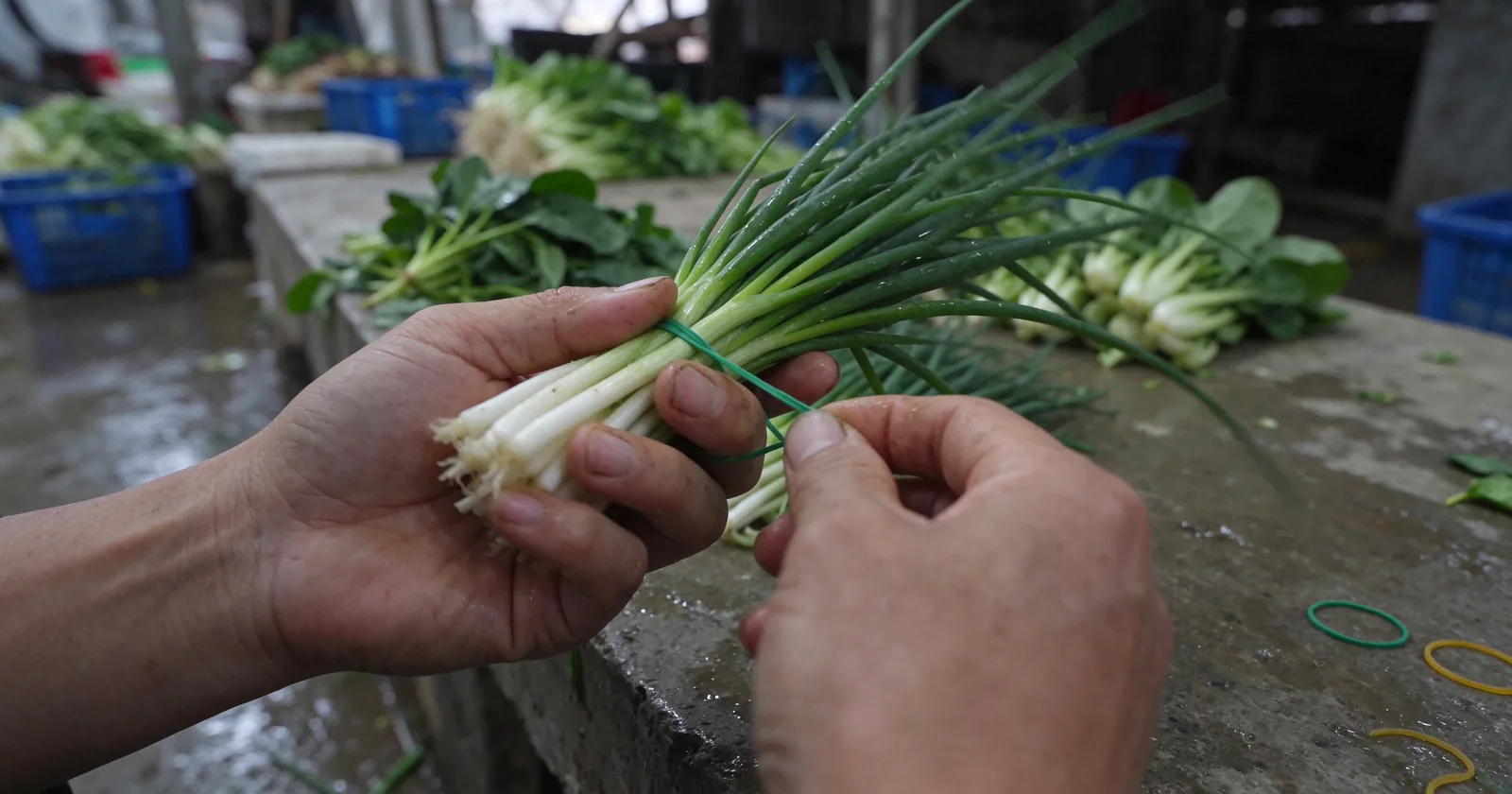
Five ways a bunch comes apart
None of these are exotic. They are the five we get asked about every week, roughly in the order they cost money.
1. The band was sized for the bag, not for the crop
A 50 mm loop on a 30 mm bunch of spring onions is already stretched close to its limit before anyone lifts it. It holds for an hour, takes a permanent set overnight, and by the second day the bunch slides out of it. Someone re-ties it at the shelf, and the second tie is always worse than the first because there is no time to do it properly.
2. The band was too tight, and the stem bruised
Go the other way and the band cuts into the stem. On chives, water spinach and thin celery, a band that dents the stem starts a bruise within a day. The bruise goes translucent, then slimy, and you see it as a dark ring around the bundle. The produce is still fit to sell and no customer will touch it.
3. The bands were stored in the cold room
Natural rubber stiffens sharply below freezing. A band that pulls to 180% at 25 °C can snap at well under 100% after a night at −18 °C. If your bands live on the shelf next to the produce, this is what is happening — and the snap usually comes when someone is stretching it over a bunch, not on display.
4. Condensation changed the grip
Wet stems and condensation make the band slide. The same loop that holds a dry bunch will creep on a wet one, and the natural reaction is to tie tighter, which brings back the bruise from point two. Wet packing needs a slightly thicker wall, not more tension.
5. The compound changed between bags
Hand-tying hides batch variation. A bunching machine does not: it picks a band, stretches it to a fixed length, and if the elongation has drifted the bundle comes out loose or crushed. Every new bag becomes an adjustment, and the adjustment is never written down.
Size: pick by bundle diameter, not by habit
The number that matters is the stretch ratio — the bundle circumference divided by the band's resting circumference. Vegetable bundling lives between 1.2× and 1.8×. Below that the band creeps; above it the band takes a set and stops recovering.
In practice that means an inner diameter of roughly 0.65 to 0.8 of the bundle diameter. These are the ranges we ship most often:
| Crop | Bundle diameter | Band inner dia. | Band width | Wall |
|---|---|---|---|---|
| Chives, spring onion, coriander | 25–35 mm | 18–25 mm | 1.5–2 mm | 1.0–1.2 mm |
| Spinach, bok choy, water spinach | 35–45 mm | 25–32 mm | 2–3 mm | 1.2 mm |
| Asparagus, celery, garlic sprouts | 45–55 mm | 32–40 mm | 3–5 mm | 1.2–1.5 mm |
| Broccoli, cauliflower, leek | 60–80 mm | 45–55 mm | 5 mm | 1.5 mm |
A wider wall at the same diameter pulls harder and lasts longer, so moving from a 1.2 mm wall to 1.5 mm is a way to add grip without changing the diameter — useful when the crop gets heavier in the second half of the season.
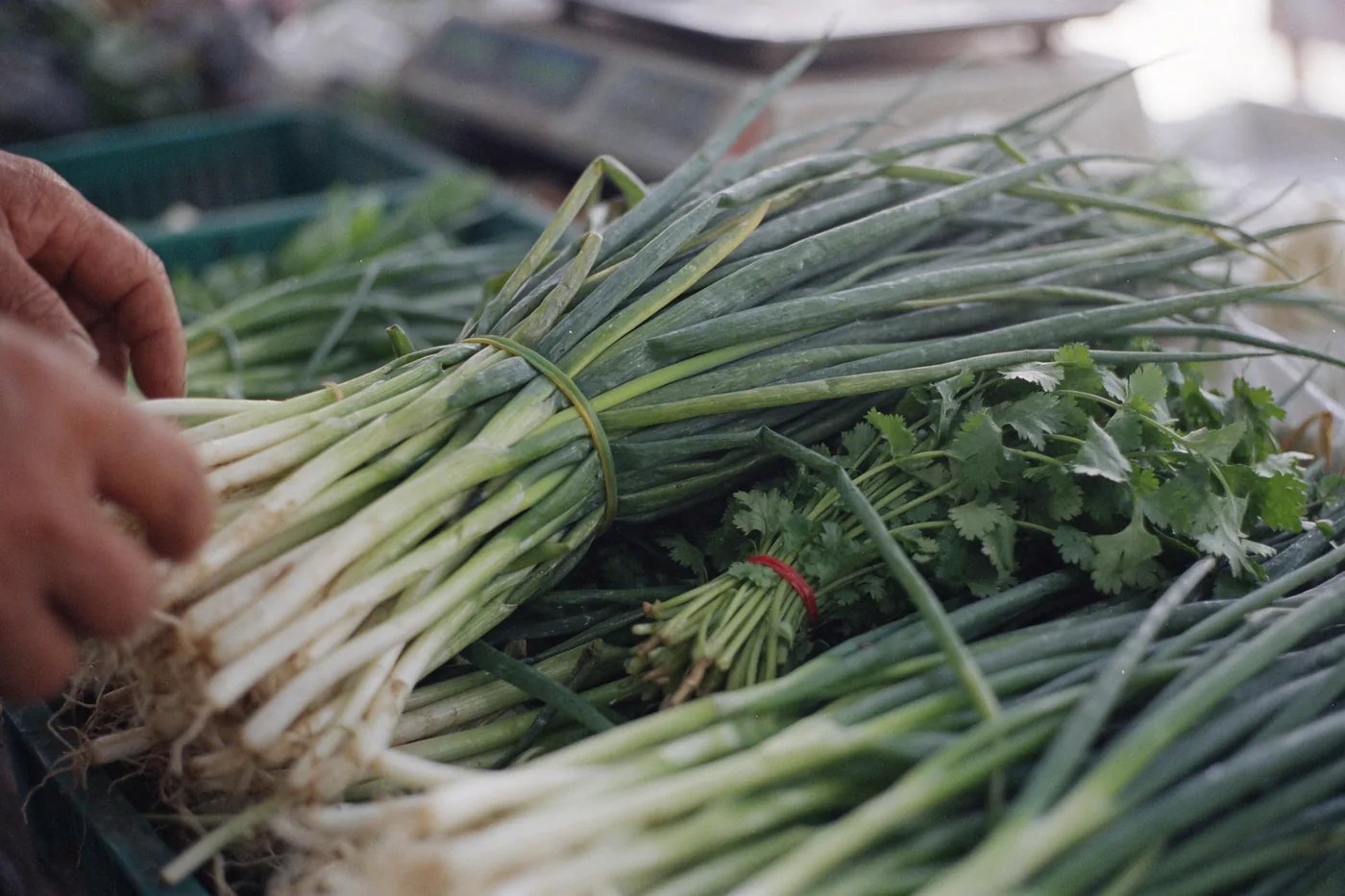
Colour is a tool before it is decoration
Most of our vegetable orders are not one colour. They are two or three, and the reason is usually one of these:
- Grading. One colour for grade A, another for grade B. The packhouse sorts faster than any label prints.
- Arrival date. Today's stock and yesterday's stock in different colours, so the shelf staff does not have to read a tag.
- Origin or grower. Red for one farm, blue for another. Returns get traced without opening the crate.
- Visibility. Yellow and red read from three metres away on a dark produce shelf. Green disappears into leafy greens — which is what you want when the tie should not be noticeable, and the opposite of what you want when it is a grading code.
If you print a logo on the band, keep it to one colour and specify an ink that does not transfer. A printed band that leaves grey marks on wet celery is worse than no print at all.
Cold chain and wet packing
Three things we tell every new vegetable customer, because they cost nothing and remove most of the breakage:
- Keep the band stock out of the cold room. Around 20 °C and below 65% humidity is enough. A sealed bag in a cold store will take on condensation and the bands will feel tacky.
- Let cold produce come up for twenty or thirty minutes before bundling. A band stretched over a frosted stem is at its most brittle exactly when it is worked hardest.
- For wet packing, go up half a millimetre of wall rather than down a size in diameter. Tension is the wrong lever here.
Food contact: read past the words on the carton
“Food grade” printed on a bag is not a specification. Three things are worth asking for instead:
- A test report with a report number. Ours come from SGS. Alongside that we hold REACH and RoHS statements. We do not claim certificates we do not hold, and if a tender needs a specific standard named, we will tell you whether we can meet it before you write it in.
- Colour migration. A dark band sitting against wet stems for a week is a migration test, not a colour swatch. Cheap pigment can bleed at the contact line; ask for the test on the actual colour you are buying, not on the natural one.
- Latex-free, if the market needs it. Natural rubber carries protein. For stores or regions where latex allergy is a stated concern, a latex-free compound keeps most of the stretch and removes the allergen.
The cost sum that actually matters
A 50 × 5 mm natural rubber band weighs about a gram, so a kilogram is roughly nine hundred to a thousand ties. At one band per bunch, the material cost of a single tie is measured in fractions of a cent. A bunch that comes apart on the shelf costs the whole bunch, plus the wage of the person who re-ties it, plus the sale you did not make.
Which is why the number to compare between suppliers is not the price per kilogram. It is how many re-ties you do per thousand bunches. Ask for that number from your own packhouse before you switch compound, and ask us for a sample lot to test it against.
What we supply
Stock loops from 20 to 70 mm inner diameter in 1 mm steps, widths 1.5–5 mm, walls 1.0–1.5 mm, in natural rubber or latex-free compound. Standard colours are green, yellow, red, blue and transparent; custom colours run against a Pantone reference. Single-colour logo printing is available on the wider walls.
Sampling: existing sizes go out within three days, free of charge, courier at your cost. Minimum order is 120 kg, lead time 15 days for the first 500 kg and 30 days at container volume. Capacity is 500 tons a month across ten lines in Dongguan.
Four starting points from the catalogue:
- Vegetable bundling bands, tight bind for market sales — the general-purpose loop for leafy bunches.
- 50 mm × 5 mm bands for supermarket packing — the heavy end of the range, for larger bunches and wet packing.
- Multi-size strong stretch bands — one compound, several diameters, for packhouses running more than one crop.
- Green vegetable bands, 1/2 inch — moderate elasticity, the size most home-delivery and small-market customers reorder.
Questions we get on the first call
Can we use our own store colour? Yes. Send the Pantone or a physical swatch. Custom colour has its own minimum, usually 120 kg per colour.
Will the colour come off on wet vegetables? Not on a compound we have tested for it. If you are buying a dark colour for wet packing, ask for the migration report on that colour before the container ships.
Can bands go straight into the freezer? They can be used in a cold room, but do not store the stock below 0 °C. Long storage at −18 °C hardens natural rubber and you will lose bands to snapping.
How fast can we see a sample? Three days for stock sizes, seven to ten days for a custom colour or print.
If you send the crop, the bundle diameter and how the bunch is handled — hand-tied or machine — we will size the loop for you rather than sell you the nearest bag. Write to amy@rubberbandking.com or message +86 189 2820 1291 on WhatsApp.
